Welcome to your IBM i update for May 2026, your monthly digest into what’s happening within the IBM i community.
In this episode of the IBM i update, we ask whether IBM i is the perfect platform for native agentic AI? How MCP will be the bridge between your data and AI automation. Ask when IBM i skills become a resilience risk and the latest on the events circuit too…
You can watch the video above or read the blog post below…
IBM Announces IBM Bob Premium
First, we start with BOB, and IBM announced this month that the Bob Premium Package for i is planned for general availability on 24 June 2026.
But what is the Premium Package?
In simple terms, it takes the foundation of IBM Bob and tailors it for IBM i.
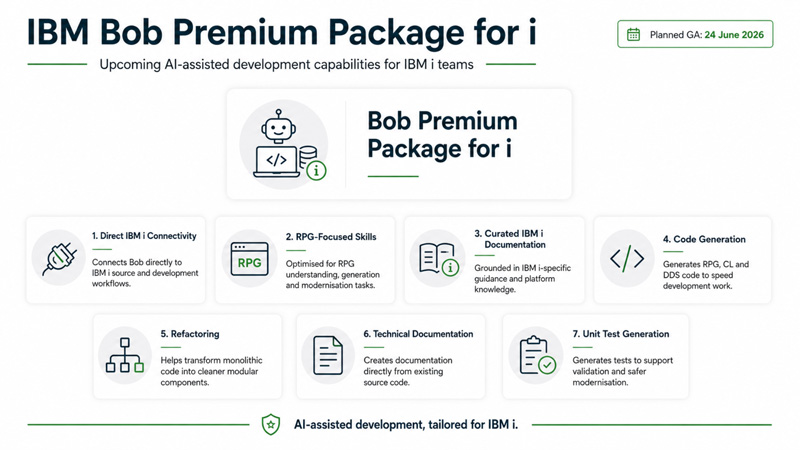
The Bob Premium Package for i adds direct IBM i connectivity, RPG-focused skills, curated IBM i documentation, code generation, refactoring, technical documentation and unit test generation.
That matters because it shows IBM is not approaching AI-assisted development on IBM i with a one-size-fits-all mindset.
Instead, Bob Premium Package for i appears designed as a platform-aware assistant that understands the realities of IBM i development, from RPG application structures through to the modernisation pressures many organisations are now facing.
Its another sign that IBM sees AI-assisted development not as a replacement for IBM i expertise, but as a way to help preserve, accelerate and extend it.
Common Norge in Oslo
Now, at the start of the month, I enjoyed the pleasure of attending the COMMON Norge Professional Day in Oslo.
This event brought together the IBM Power community for a packed agenda centred on Power11, AI and the evolving role of IBM Power in enterprise technology.
Hosted at the IBM Client Centre, which was just a nice walk along the riverbank from my hotel in the centre, the event combined strategic sessions from IBM experts with practical technical content for the wider Power and IBM i community.
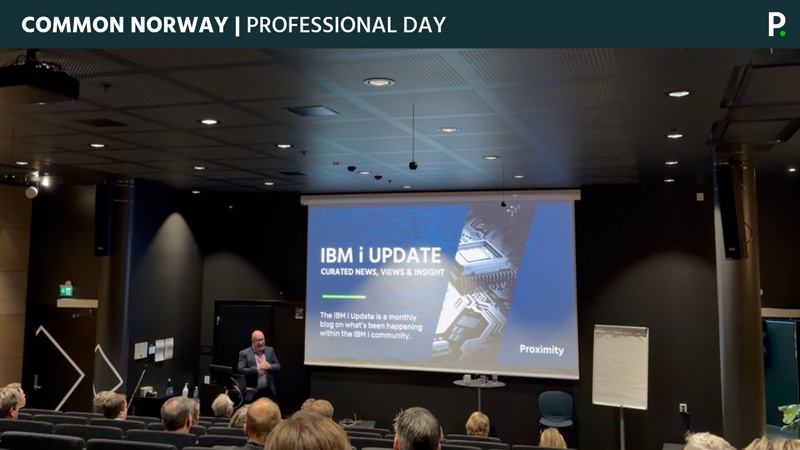
The day opened with a focus on Agentic AI, exploring how organisations can move beyond isolated AI projects and begin turning artificial intelligence into operational and commercial value.
This theme continued throughout the agenda, with sessions showing how IBM Power is being positioned as a secure, resilient and increasingly AI-ready platform for mission-critical workloads.
I enjoyed meeting new contacts, and the food and company were excellent. Now, I wish I could report more, but unfortunately, the majority of the presentations were in Norwegian – thankfully for me, the slides were mostly in English, so I was able to follow along.
There was one presentation in English, however, and that was mine!
Yes, for the first time, I presented an IBM i Update live.
Here I covered a few pertinent articles from recent updates, including project BOB, what AI means for IBM i developers and analysing the results of the IBM i Marketplace Survey.
My summary? Well, what stood out most was the direction of travel. IBM Power is no longer being discussed purely in terms of stability and reliability, although those qualities remain essential. Increasingly, the conversation is about how the platform can underpin AI, automation, modernisation and secure enterprise innovation.
My thanks to Erik Aasland and the Common Norge team for their invitation and hospitality.
Is IBM i the perfect agentic AI operating system?
Now, while IBM i was not designed for the AI era, many of the design decisions that made it successful may now make it ideal for enterprise AI. So, could IBM i be the perfect agentic operating system?
Well, this was a prevailing theme that ran through the PowerUp event in New Orleans at the end of April.
That IBM may be repositioning IBM i entirely – not just to survive the AI era, but to lead in it.
And that’s because of the intrinsic nature of the architecture of IBM i that provides the foundation layers the AI needs to operate effectively…
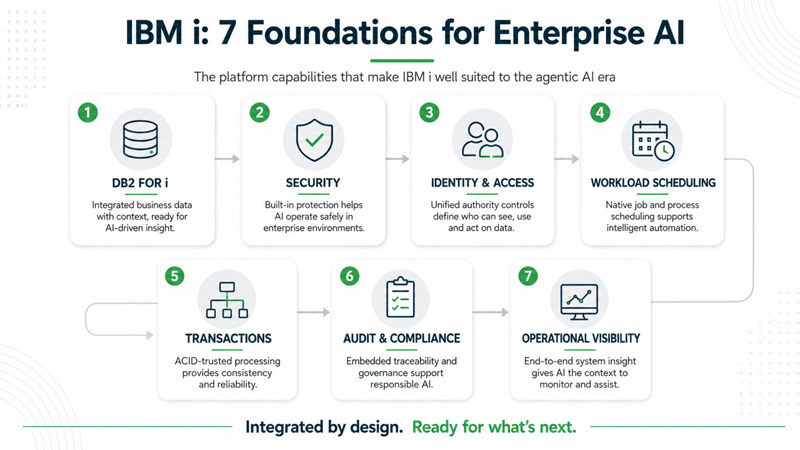
Now, this starts with data.
And unlike many open systems environments, where organisations often have to stitch together databases, data lakes, middleware, security layers and governance tools, IBM i already has its core business data tightly integrated into the platform through its integrated Db2.
And this matters! Because AI is only useful when it can access trusted, meaningful, well-governed data.
For IBM i customers, the data often already sits alongside the business logic, security model and operational processes that give it context. That makes IBM i a strong candidate for AI use cases such as:
- Querying live operational data
- Generating business insight
- Supporting decision-making
- Monitoring transactions
- Helping users understand trends and exceptions
The point is not just that IBM i has data. It has business-critical data with context.
In addition, Enterprise AI cannot simply be allowed to wander through business systems unrestricted.
There has to be security in place to help protect the system and data integrity, without being overtly complex, to set up and manage and of course, this is where IBM i has a natural strength.
Security and identity are not bolted on as an afterthought.
They are part of the platform’s design, and that gives IBM i a credible foundation for AI that is not just clever, but controlled.
AI needs to know:
- Who is asking the question
- What that person or agent is allowed to access
- Which actions are permitted
- Which data should remain protected
- How authority is controlled
For agentic AI, this is vital. If an AI assistant or agent is going to interact with live business systems, it must operate within a controlled authority model.
IBM i already has strong native concepts around users, object authority, adopted authority, auditing, access control and system-level governance.
Then there’s access and identity. You see, agentic AI needs to know who is asking, what they are allowed to see, and what actions they can perform.
IBM i already has strong user profiles, authority models and access controls to manage trust, permissions and accountability across the platform.
Now, AI agents are not just chatbots; they may need to run tasks, monitor activity and trigger processes.
IBM i already has native capabilities around job scheduling, batch processing, job queues, message queues and operational state.
These are the kinds of platform-level capabilities that AI agents need if they are going to become useful inside real enterprise environments.
Or, In other words, IBM i already understands how to run business processes reliably. This is a major advantage when you start thinking about AI agents that need to support operations rather than just produce text.
AI agents need to understand:
- What task are they performing
- When should it run
- What happened previously
- What state is the process in
- Whether something is completed, failed, or requires attention
IBM i has always been trusted for transactional workloads. Orders, invoices, stock movements, financial postings, warehouse updates and customer records need to be processed accurately and reliably.
For AI, this is critical.
If AI is going to make recommendations, explain what happened, support users, or eventually trigger actions, then businesses need confidence that the underlying platform can maintain integrity.
That means:
- Transactions must be reliable
- Changes must be traceable
- Activity must be auditable
- Compliance requirements must be supported
- Business-critical processes must not be compromised
IBM i’s strength here is that auditability and transactional integrity are deeply embedded in the platform. This makes it far better suited to serious enterprise AI than environments where governance has to be created after the fact.
If AI is going to support or take action in enterprise environments, businesses need traceability and IBM i already has strong auditing, logging and compliance capabilities built into the platform.
The final point is operational visibility.
AI becomes much more useful when it can understand not just the data, but the wider operating environment. IBM i can expose a huge amount of system information through logs, messages, jobs, queues, SQL Services, performance data and operational monitoring.
This is where IBM i Services and SQL Services become particularly important. They provide a structured way to access system information, which can then be used by AI tools, assistants or agents.
That opens the door to AI use cases such as:
- Summarising system health
- Identifying abnormal activity
- Explaining job failures
- Helping support teams triage incidents
- Reviewing performance trends
- Surfacing risks before they come out
So, what does this mean?
Well, simply speaking, Enterprise AI needs more than a large language model. It needs a trusted operating environment around it.
It needs integrated data, security, identity, scheduling, transaction integrity, auditability and operational visibility.
And these seven foundations are not new concepts on IBM i.
They are part of the platform’s design. And that is what makes IBM’s positioning so interesting.
While many organisations are trying to assemble these capabilities across multiple tools and platforms, IBM i customers may already have much of the required foundation in place.
How MCP is the bridge between IBM i and agentic AI
Now, while the foundational aspect is all there within IBM i, we’ll still need to connect and interact with external systems, tools and data sources.
That’s where MCP (or Model Context Protocol) comes in.
You see, MCP acts as the bridge between IBM i and Agentic AI… Because AI is only useful when it can work with real business context, across the enterprise.
So, your IBM i will already contain huge amounts of trusted operational data within the Db2. However, other operational data, services and processes may be within external systems – perhaps stored within SQL.
MCP gives AI agents a way to access that information in a structured, controlled and useful way.
That means an AI model could, for example, connect to IBM i data, query sales information, review operational trends, inspect system status, or help produce reports based on live enterprise data.
Jesse Gorzinski demonstrated this idea at POWERUp, showing how an IBM i-based MCP server could connect an AI model to sales data in Db2 for i and then generate a PowerPoint presentation from the insights it found.
The important point is that this is not about wrapping a chatbot around an old system.
As Adam Shedivy explained at POWERUp, the opportunity is to build agents that participate in the operating model itself: agents that can reason, decide and act over business processes in a controlled way.
And this is where IBM i becomes especially compelling.
Because the platform already has the core capabilities agentic AI needs: identity, security, scheduling, state management, auditability and access to trusted data.
MCP does not replace those strengths. It exposes them to AI in a more modern and standardised way.
That is why MCP could become such an important part of the IBM i AI story. It provides the connective tissue between AI models and the live enterprise systems where real business happens.
In other words, MCP may be the mechanism that allows IBM i to become not just AI-enabled, but genuinely agentic-ready.
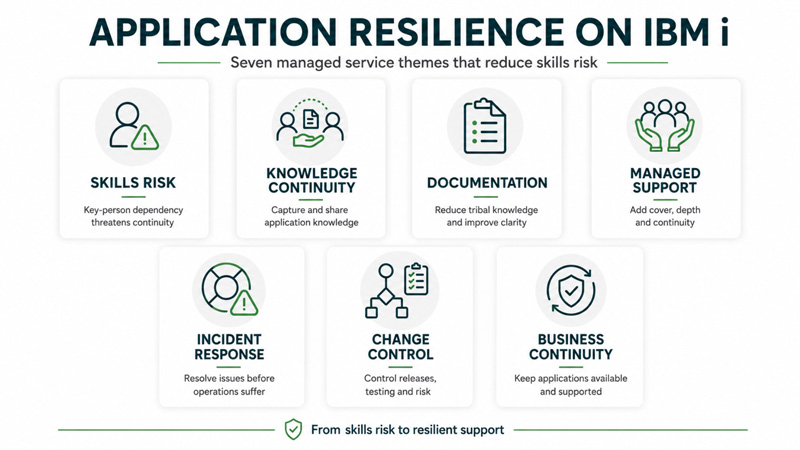
The IBM i skills gap could be your biggest resilience risk
IBM i has always had a strong reputation for resilience.
For many organisations, that resilience conversation has traditionally focused on infrastructure: hardware reliability, backups, high availability, disaster recovery, replication, role swaps, cyber recovery and data protection. All of that matters.
But there is another form of resilience that is becoming just as important: application resilience.
That same argument applies just as strongly to the applications running on IBM i. Because for many businesses, the real risk is not simply whether the IBM i platform is available.
It is whether the business has the right people, knowledge and support model in place to keep the applications running, changing and recovering when needed.
One of the most important observations in Ash Giddings’ article is that deep IBM i knowledge is often concentrated in a small number of individuals.
These are the people who understand the nuances of the environment, the dependencies between applications, and the practical steps required when something unusual happens.
I’m sure that this will sound familiar to many IBM i customers:
- They know which jobs need to run in which order.
- They know which programmes were changed for a specific customer requirement ten years ago.
- They know which interfaces are business-critical, even if they are not well documented.
- They know what to check when a warehouse process, invoicing run or EDI flow fails.
- That knowledge is incredibly valuable.
But if it exists only in people’s heads, it is also a risk.
When those individuals retire, move roles, reduce hours, go on holiday or are unavailable during an incident, the business can quickly discover that its application resilience is weaker than expected.
High availability can help keep systems running. Disaster recovery can help restore or switch environments. Infrastructure resilience is essential.
But application continuity depends on more than the machine being available.
A business also needs to know:
- Who understands the application landscape
- How core processes work
- Where the customisations are
- What dependencies exist between systems
- How incidents are triaged and resolved
- How changes are tested and promoted
- How support is provided when the internal expert is unavailable
This is where application managed services become part of the resilience conversation.
The objective is not simply to outsource support. It is to reduce dependency on individual knowledge and build a more sustainable operating model around the application estate.
Many IBM i applications have been developed and refined over decades. That is often a strength. These systems reflect the business in detail and support processes that generic software would struggle to replicate.
But over time, documentation can drift. Development standards can change. Interfaces can multiply. Batch processes can become harder to understand.
Business logic can become embedded in code, procedures and operational routines that are not always visible to new team members.
A good application managed service should help turn that tribal knowledge into managed knowledge.
That means building an understanding of:
- The application structure
- Core business processes
- Key programmes and data flows
- Batch schedules and dependencies
- Interfaces to third-party systems
- Known issues and recurring incidents
- Change and release processes
- Business-critical periods and operational priorities
This is not a one-off exercise. It should be part of an ongoing service model, where knowledge is continually captured, refined and shared across a wider team.
That is what reduces resilience risk.
A more mature approach would ask:
- Are key applications documented?
- Are critical processes understood by more than one person?
- Are interfaces mapped?
- Are batch schedules and dependencies visible?
- Are support procedures repeatable?
- Are changes tested and promoted in a controlled way?
- Are external specialists familiar with the environment before an incident occurs?
- Is there a plan for retirements, absence or skills loss?
These questions are not always comfortable, but they are necessary.
And the time to act is before the skills walk out the door. Many organisations only address IBM i skills risk when it becomes urgent.
- A key developer retires.
- A support analyst leaves.
- A critical incident exposes a knowledge gap.
- A project stalls because nobody fully understands an area of the system. A business change becomes risky because the application impact is unclear.
And by then, the business is already on the back foot.
A better approach is to treat application knowledge transfer as a planned resilience activity.
That can include discovery, documentation, shadowing, support onboarding, code analysis, process mapping and gradual transition into a managed service model.
The aim is not to replace internal teams. In many cases, the best model is a blended one: internal business knowledge supported by external IBM i specialists who provide depth, cover and continuity.
That gives the organisation more confidence and avoids the classic risk of relying on one or two people to carry an entire application estate.
IBM i remains one of the most resilient enterprise platforms available.
But platform resilience is only part of the story.
If the applications running on IBM i are critical to the business, then the skills, knowledge and support model around those applications must be treated as part of the resilience strategy too.
High availability protects the environment.
Disaster recovery protects the recovery path. And Application managed services protect the knowledge, support and continuity around the business logic itself.
That distinction matters.
Because when IBM i skills become scarce, the risk is not just technical.
It’s operational, it’s commercial, it’s organisational.
And for many businesses, the real question is no longer whether IBM i can keep running.
It is whether the people and processes around it are resilient enough to keep the business running with it.
i-UG’s i-Power 2026 event preview with Steve Cast from Fresche
And finally, we’ve a couple of events coming up that I’ll be attending and even speaking at – yes, in the middle of June, we have the COMMON Europe event in Lyon France.
Now, if you’re looking to attend, please join me for the IBM i Update Live – yes, a presentation of some of the hit articles and a little more will be presented by me late Monday afternoon. Do join me if you can.
But before then, we have the i-Power event in Milton Keynes at the beginning of June.
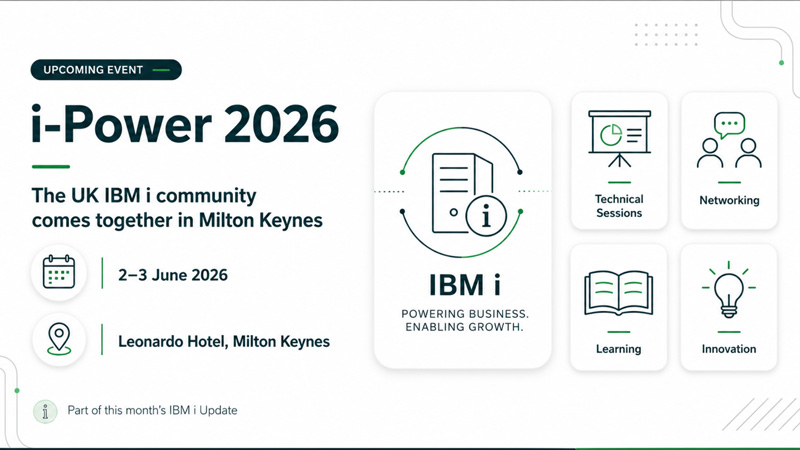
I’ll be there too, hosting the Proximity/Fresche booth at the event.
Please do come and say hello!
Now if you’re ‘umming and arring’ about attending, or just don’t know what to expect – I spoke with COMMON Board member Steve Cast to provide an insight and a bit of a preview. You can see the full interview here:
Time is now of the essence, so if you would like to join the event, please register here – https://iugipower2026.sched.com/
And that’s it for this months update.
I’m Andrew Nicholson, and we’re Proximity, your application support, maintenance and development partners that are in your corner.
If you missed it, catch up on our April IBM i update.
Follow this link to access all the IBM i Update’s in one place.
Alternatively, if you’d like to receive the latest IBM i Update hot off the press to your inbox, subscribe to the newsletter version on LinkedIn.