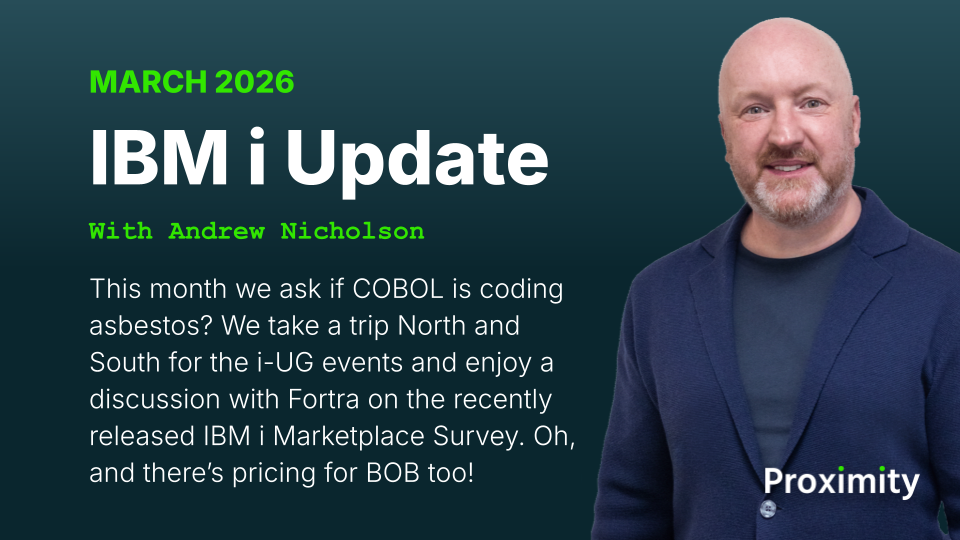
Welcome to your IBM i update for March 2026, your monthly digest into what’s happening within the IBM i community.
In this edition, we’ll look at whether COBOL is the asbestos of programming languages, as described by WIRED, the results of the Fortra IBM i Marketplace Survey 2026 with Mike Davison, a summary of iUG North in Rochdale and iUG South at IBM London, and dive into the recently announced pricing for IBM Bob!
You can watch the video above or read the blog post below.
COBOL: Is it the asbestos of programming languages?
A recent WIRED article called COBOL “the asbestos of programming languages” not because it’s inherently bad, but because it’s everywhere, deeply embedded, and extremely difficult to remove.
But it misses the real issue, replacement isn’t necessarily the answer. What the article fails to observe is that COBOL isn’t failing.
For decades, it has underpinned vast amounts of global infrastructure, particularly in finance and government, where it continues to run critical, high-volume systems.
The challenge isn’t that it doesn’t work, it works exceptionally well… but that the knowledge required to maintain and evolve these systems is becoming increasingly scarce.
This framing feels especially relevant in light of the latest Fortra IBM i Marketplace Survey.
For those who missed last month’s update, I reported that for the first time in nearly a decade, IBM i skills, not cybersecurity, is now the number one top concern for organisations, with around 69% of respondents highlighting the skills shortage as a top issue.
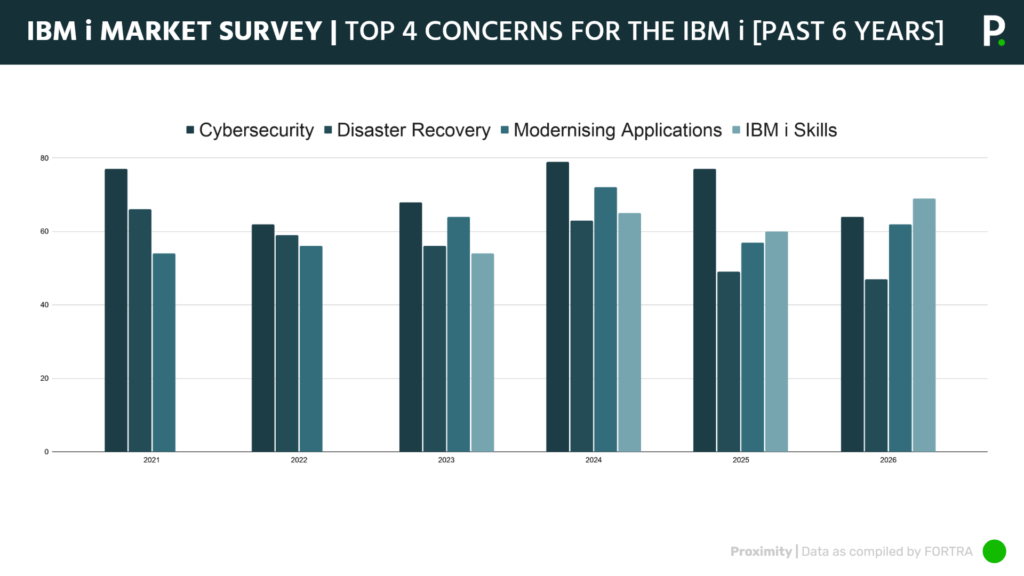
This marks a significant shift. For years, security dominated the conversation.
Now, the industry is recognising something more fundamental, “You can’t secure, modernise, or even run a system if you don’t have the people who understand it.”
Now, couple this with COBOL’s importance in running the world, you start to see the bigger picture.
For example, over 200 billion lines of COBOL code are running as I speak – that accounts for nearly 80% of all working code.
You see, COBOL still quietly powers much of the modern world. Credit card payments, airline bookings, government services – all still depend on it to function.
A quick example, during the pandemic, when demand for services surged, cracks began to show.
Unemployment systems didn’t fail because of infrastructure, they struggled because there weren’t enough COBOL specialists available to maintain and adapt them.
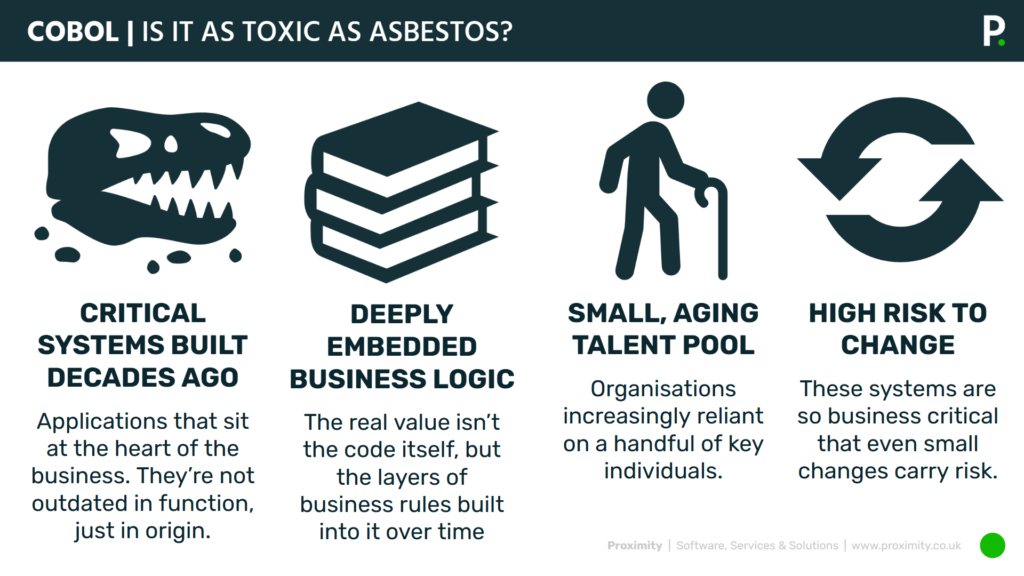
And within the WIRED article, this too highlighted these same structural problem that are echoed within IBM i estates:
Critical systems built decades ago
Many of these applications sit at the heart of the business — handling finance, logistics, and operations — and have been refined over decades. They’re not outdated in function, just in origin.
Deeply embedded business logic
The real value isn’t the code itself, but the layers of business rules built into it over time — often undocumented, tightly coupled, and difficult to separate without risking unintended consequences.
Small, ageing talent pool
Skills haven’t scaled with demand. Experienced developers are nearing retirement, while fewer new entrants are coming through — leaving organisations increasingly reliant on a handful of key individuals.
High risk attached to change
These systems are so business-critical that even small changes carry risk. Large-scale replacement or transformation programmes can introduce more uncertainty than stability, which is why many never fully materialise.
And just like COBOL in the article, IBM i environments aren’t being replaced at scale, they’re being maintained, extended, and cautiously modernised.
What’s the solution for COBOL?
So, I see the WIRED article more like a wake up call, because this isn’t about legacy technology anymore – it’s about operational risk.
And, replacing systems introduces risk at great expense.
The argument here is, “Why remove rock solid code that has worked and continues to work reliably and efficiently and introduce uncertainty?”
The idea of replacing COBOL sounds clean on paper, but in reality it means rewriting years, sometimes decades of business-critical logic, much of which isn’t fully documented.
That introduces risk, cost, and uncertainty.
Refactoring keeps the core logic but restructures it, improving maintainability while preserving what already works.
Recoding sits somewhere in between, translating existing functionality into a new language or platform – these days.
Each approach has its place, but all carry cost, complexity, and risk.
Modernisation, however, allows you to keep the concrete foundations that already hold the business up, and build new capability around them.
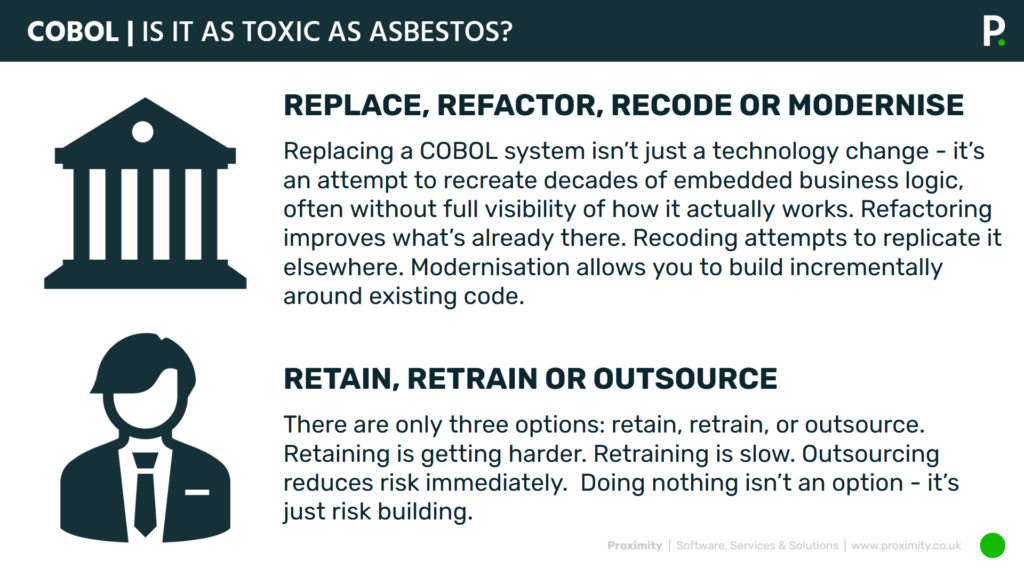
And then on the human front, organisations facing the COBOL skills challenge really have three choices: retain, retrain, or outsource.
Retaining experienced developers provides continuity but becomes harder as the talent pool shrinks.
Retraining internal teams can work, but it takes time and still relies on having enough existing knowledge to transfer.
Outsourcing to a managed service provider offers a more immediate and structured solution, bringing in proven expertise, reducing dependency on individuals, and ensuring the system is properly supported.
The key is making a conscious decision, because doing nothing simply allows the risk to grow over time.
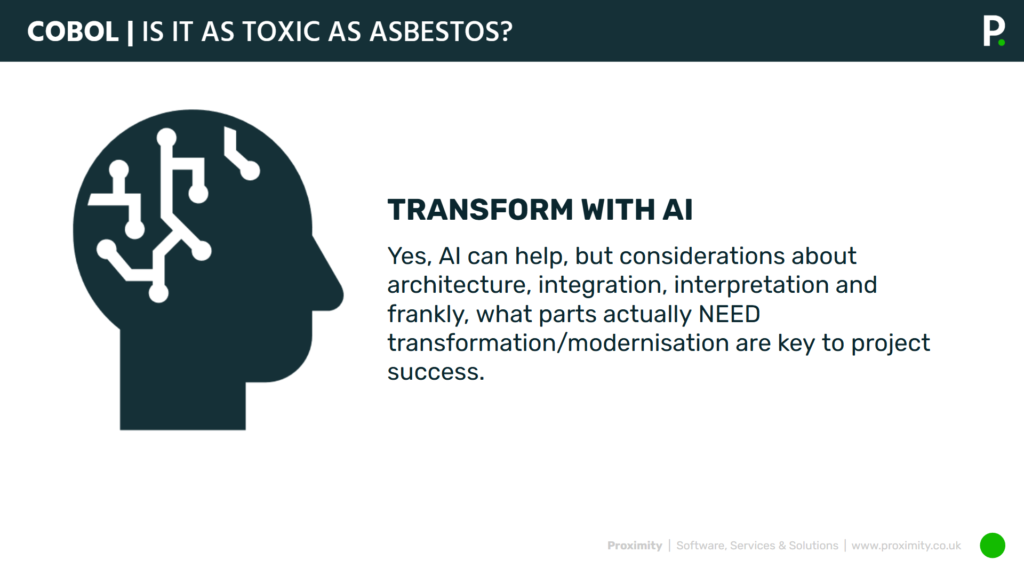
And then what of AI?
Could this help with resourcing, refactoring or modernising? AI can certainly help.
Indeed, in February, Anthropic announced that Claude can automate the analysis and migration of legacy COBOL code.
However, considerations about architecture, integration and operational risk are key to a project’s success.
As IBM stated, “translating code is one thing, modernising a platform is something else entirely.”
You see, the real challenge isn’t the COBOL language, it’s everything around it.
Compliance, procedure, operational process, audit, middleware – years of bespoke tooling and code factored in organically around the core systems.
So, using AI to modernise legacy code is a bit like using an automated translation tool. You can translate Chinese into English and get something that looks broadly correct, but without someone who truly understands the language, you risk losing the nuance, context, and meaning behind it.
So, to bring the WIRED article to a conclusion, is COBOL asbestos? No, it’s reinforced concrete. Old, yes, but still holding everything up. A proven foundation to build on, not rip out.

The real question isn’t whether it works – it does. It’s how you design the next layer, how you evolve it, support it, and build on top of it.
The foundations are already there. The decisions are what you do next…
Discussing the 2026 IBM i Marketplace Survey with Mike Davison from Fortra
Now, last month Andy Nicholson reviewed the Fortra IBM i Marketplace Survey.
If you’ve not had the opportunity to review the results, you can find his thoughts in the previous episode of the IBM i Update here: Fortra Marketplace Survey 2026 results and trends
This month, Andy had the good fortune to speak with Fortra Stalwart and IBM Champion, Mike Davison, to discuss his thoughts on the results.
Why has IBM i skills overtaken cybersecurity as the top concern for IBM i professionals?
Andy Nicholson: Now, for the first time in nine years, the IBM i skills gap has overtaken security as the number one concern in the Fortra survey. What do you think has driven that shift?
Mike Davison: I’m sure it’s down to people retiring and no one being available to replace them. Us Gen-Xers who pioneered IBM i are reaching retirement, and because of the perception that IBM i is “legacy” and not cool, younger people aren’t as interested.
However, shifts in development such as using Git and Visual Studio Code and modernisation programmes using AI will help. But I can’t help feeling that the platform is behind the skills curve by quite some distance right now.
Any surprising trends this year?
Andy Nicholson: What was the most surprising trend you observed compared to last year’s results?
Mike Davison: It was absolutely code development shifting by 13% towards using AI. That’s the biggest movement in the whole survey.
It really shows that companies are embracing the AI age, which is great given that the talent pool is shrinking. It’s a strong way to help offset that deficit, and I think it’s a very good use of AI.
What’s driving software and hardware upgrades on the IBM i?
Andy Nicholson: The survey shows a record 70% of organisations planning hardware or software upgrades in 2026. What’s driving that level of urgency? Does it feel like a tipping point for the platform?
Mike Davison: In terms of hardware, Power9 went end of support at the end of January this year, which means no further patches, microcode, or security fixes. With the announcement of Power11 last year, sensible customers will be looking to upgrade their older systems to stay current.
Let’s also remember that Power9 launched in 2017–2018, which is eight years ago, that’s a long time in computing.
The other key factor is that Power9 doesn’t support IBM i 7.6, which was released in April last year. So anyone on Power9 who wants IBM i 7.6 and all the new features will need to upgrade both their hardware and operating system.
What security threats are IBM i users facing?
Andy Nicholson: While cybersecurity has been eclipsed as the top concern, it still ranks highly. What do you believe is the biggest security worry respondents are now facing?
Mike Davison: If we look at the top three concerns from the report:
First, threats are constantly evolving, which creates anxiety around a moving target. Second, the skills gap we discussed earlier, there’s a growing lack of security knowledge on the platform. Third, balancing security controls with business efficiency.
Many customers need to meet regulatory requirements, and when you combine that with the skills gap and evolving threats, it creates a perfect storm.
As I’ve said before, IBM i is highly securable, you just need to know how to do it properly.
What modernisation strategies are gaining momentum?
Andy Nicholson: Based on the survey, what modernisation strategies do you see gaining momentum in the IBM i space?
Mike Davison: 35% of respondents are now using AI for code development, and 68% see it as the future. That’s a significant shift in how development is approached, and it should help make the platform more appealing to younger developers.
However, companies need to modernise their applications, not just their development processes.
The survey shows that 73% of businesses are running in-house applications and 88% are coding in RPG. That’s something that needs a long, hard look as well, in my opinion.
How is IBM i development evolving?
Andy Nicholson: For the first time, Visual Studio Code usage has surpassed RDi. What does this tell us about how IBM i development is evolving?
Mike Davison: RDi is designed specifically for IBM i, whereas Visual Studio Code is a feature-rich, flexible development tool. It integrates well with Git and supports modern development practices.
More companies are adopting Git for source control, and VS Code works very well with that. Even myself, as a non-developer, I’ve moved to VS Code for CL and scripting, it’s simply easier for deployment and version control.
What’s your view on IBM’s Bob?
Andy Nicholson: That makes good sense. Now, IBM has been talking about tools such as BOB to support AI-assisted development on IBM i. What’s your view on BOB and what it will actually do in practice?
Mike Davison: Right now, I see BOB as a tool that can help document legacy code, improve it, and assist with development.
Steve Will’s vision is much broader, BOB supporting the entire modernisation journey from start to finish. That includes writing new RPG code, refactoring legacy code, debugging, unit testing, mentoring, documentation, and even project planning.
A lot of people are excited about it, and after seeing a live demo at Tech Exchange in Orlando last year, I can understand why—it really is impressive.
That said, its true capabilities are still to be fully realised across the wider market.
What does a well-prepared IBM i organisation look like in 2026
Andy Nicholson: When you look at the combination of skills shortages, increased upgrade activity, evolving tooling, and ongoing security concerns, what does a well-prepared IBM i organisation look like in 2026?
Mike Davison: For me, it’s an organisation that is up to date with patches and running on supported hardware and software.
It’s using modern tooling like Visual Studio Code and Git, recruiting and retaining talent with competitive salaries, and avoiding single points of failure—whether that’s a person or a system.
Ultimately, it’s a constantly moving target. If you don’t keep up, it becomes far more expensive to catch up later.
I still see many customers running outdated operating systems or ISV software and wondering why they have problems. Staying current is simply part of the cost of doing business.
IBM i Marketplace Survey 2027 release date
Andy Nicholson: We’ll look forward to the next IBM i Marketplace Survey in 2027. When do you expect that to be released?
Michael Davison: It will likely be around February 2027. We’ll begin collecting responses in October or November this year.
Hopefully, we can increase participation year on year to build an even clearer picture of the market.
Andy Nicholson: It’s incredibly important for the community moving forward. Mike, thank you for your efforts on the survey, thank you to Fortra, and I wish you a very good day.
Mike Davison: Thank you very much, Andy. Until next time!
iUG North & South Summary
In the past few weeks, I’ve been travelling the length and breadth of the country visiting the i-UG North and South. Here’s my quick take on both.
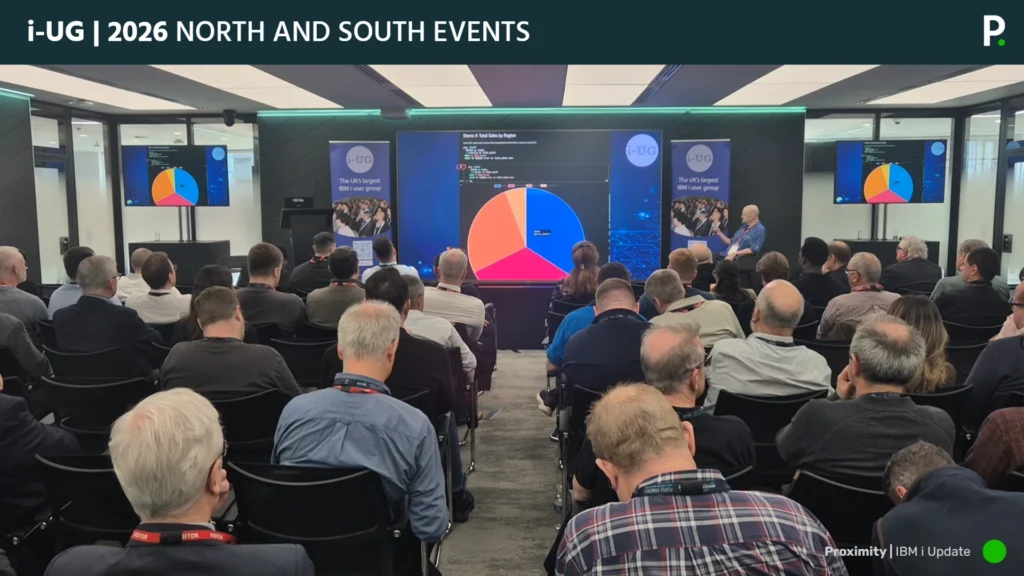
First, for the early starters, it’s always reassuring that the good people at i-UG know how to feed their audience.
At both North, hosted at their spiritual home in Rochdale and South, at IBM in London, on arrival you were treated to an assortment of pastries plus the obligatory bacon butties in Rochdale.
IBM stole the show however with their ‘drinks dispenser’ that did everything from a latte to cappuccino with a myriad of options for milk, espresso strength… the works (you’ll have to watch the video).
Someone in the queue likened it to IBM MQ, a wealth of options but complicated to operate – i liked that.
London too was by far the grander of locations, you were greeted by IBM’s first quantum computer as a display piece in the (rather plush) lobby before collecting your guest pass and being whistled up a few stories to the think suite in which hosted the days proceedings.
Both North and South shared the same agenda and I’ll pick out some pertinent parts to give you a flavour on what it’s like to attend.
Education is always a focus for i-UG and Chairman Mike Ryan discussed their i-ignite initiative of which continues to grow.
Essentially, this initiative has been set-up with partnering universities to train the next generation of IBM i professionals and some of the students who were on the course were at the event to network and learn more.
The keynote speech was conducted by board members, each providing their own insight.
Andy Youens, for example, explained that while in the past he eulogised about ACS, a better method today could be the use of the DB2 for i VS Code extensions to run SQL statements and display the results in a number of more ‘friendly’ ways.
He went on to say that with VS Code you have more flexibility in the way you can chart with selections, filters and queries completed at a click.
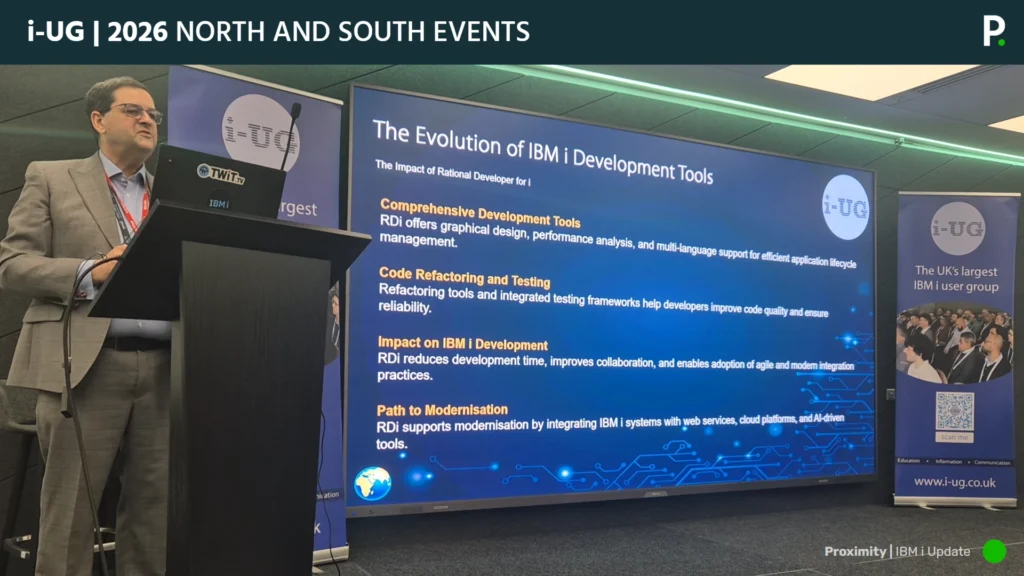
Steve Cast provided insight into the evolution of IBM i development tools from SEU way back in the late 1980’s right up to IBM Bob in 2026.
Demonstrating how far we’ve come in the past 40+ years and why developers today have never had it sooo good.
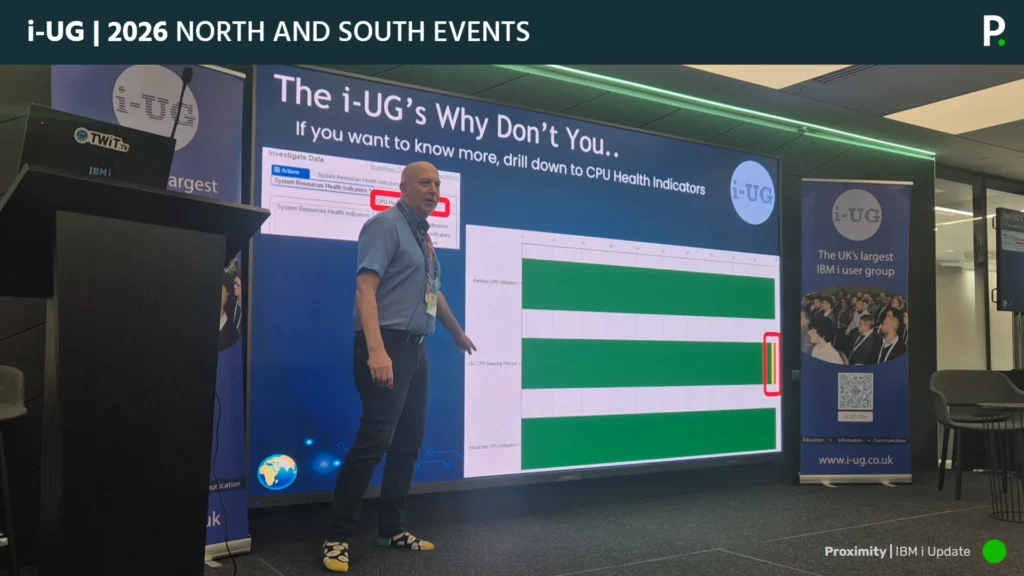
Steve Bradshaw gave us an episode of ‘Why Don’t You?’ and gave us short and simple but valuable advice on areas such as, how to check if you’re being hacked?
How to check if your system is up to date and performing well and how to check for obsolete users too.
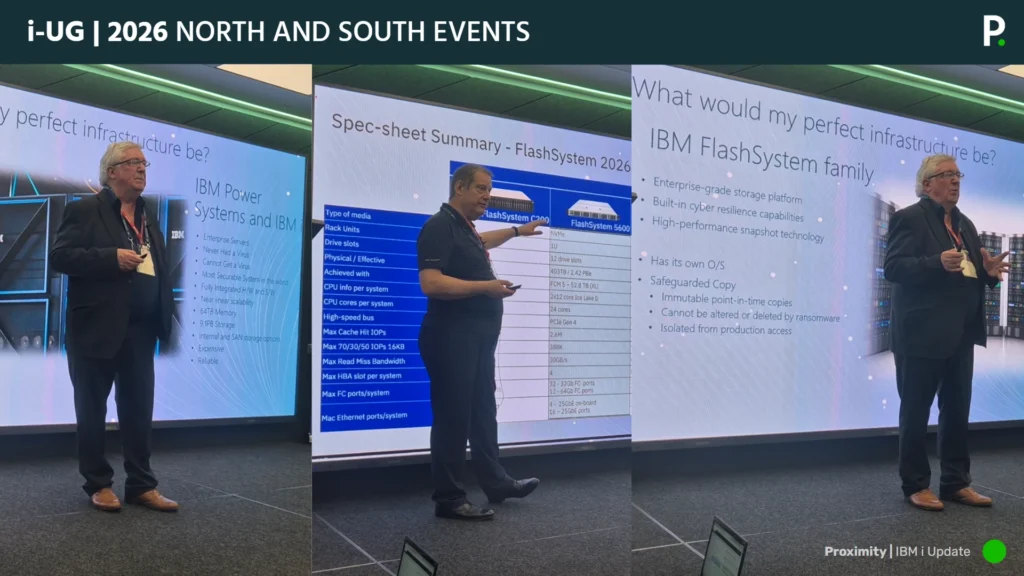
But I think of most value was the topic of backup and protection. Here Mike Ryan presented with Eddie Chaffin of ABP Food Group and I always feel it valuable to learn how people have solved problems in real-life scenarios.
Mike opened with the case study of JLR and their effects of the cyber attack inflicted on the business last year – completely shutting down production for five weeks causing over £500m in losses and costs.
To mitigate risk, Mike put forward his perfect infrastructure that included FlashSystem SAN storage and FlashCopy.
The real-word example that Eddie is to use in 2026 was with the FlashSystem 5600. Just above entry level, this 24 core CPU system chewed through 30GB a second… the top spec 9600 moved at a whopping 86GB/s – think about it, in some instances that’s a businesses entire enterprise system flash copied in just a couple of seconds.
Is it expensive, well, yes it is, but not half as expensive as the situation in which faced JLR.
Now, lunch is always a treat at IBM and this year didn’t disappoint. The spread was a delight and a special mention to the fish pie, which was some of the best lunch time eating I’d done all year.
One final presentation I’d like to cover and keeping with the ‘business resilience’ theme, was on Power Virtual Server and the growing ecosystem that IBM is delivering.
Here, Tonny Bastiaans provided insight into how IBMs offering provides a 70% better total cost of ownership over AWS and Azure on IBM i but more than that, Power11 is available with the ability to decouple the OS from physical hardware for virtual serial number licensing.
Today, IBM have 1000+ clients and 24 worldwide datacenters with resilience baked into the offering to provide almost instant server crossover.
We (Proximity) even got a mention with our use of PowerVS for disaster recovery, in which we are now able to recover 50% faster, with optimised performance at 80% less cost.
There was a lot to unpack in his presentation and if you’re looking at virtual servers – this would be the place to start.
There was more packed into the day and if you stuck around until the end, you could have enjoyed a tour and demonstration of various IBM technology including spot the dog.
Pricing for IBM Bob
Now, we’ve all seen the hype around Project Bob… I’ve done a number of posts in the Updates in previous episodes. But what’s been less clear, is how much it would cost. Well, that is until now. Following the announcement, Nick Litten broke this down, and it’s worth understanding because for the majority of us, this is likely how AI tooling on IBM i is going to be consumed going forward. To read the full blog post from Nick Litten, click here.
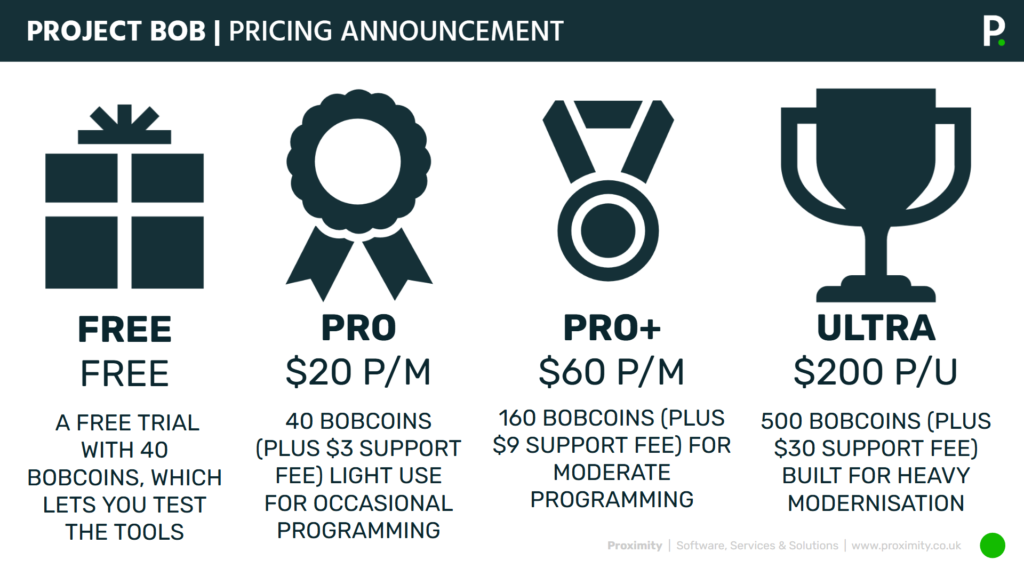
So, Bob allows you to have a free trial with 40 BOBCOINS… I’ll get to those in a minute. Once they’ve been consumed or a month has elapsed, you have a choice of three tiers. First, Pro at $20 per month is a continuation of the 40 BOBCOIN model, so if you’re an occasional coder, a solo developer or a small shop, this may be the tier for you. Next is Pro+, this provides 160 BOBCOINS and may be the sweet spot for most IBM i shops while Ultra is $200 per user per month and provides 500 BOBCOINS, the tier for heavy coding and modernisation.
What are Bobcoins?
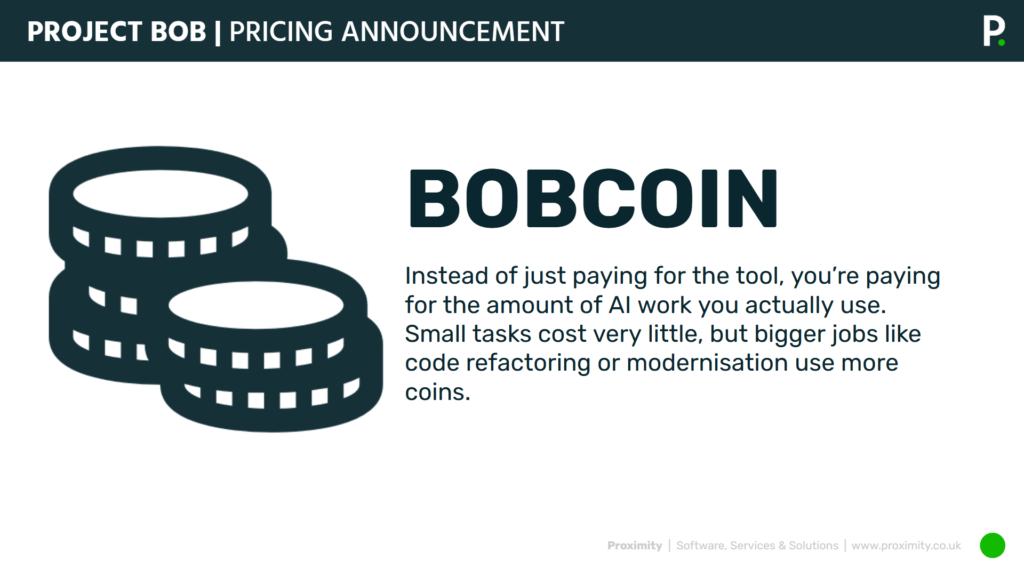
So, what are BOBCOINS? Bobcoins are essentially usage credits. Instead of just paying for the tool, you’re paying for the amount of AI work you actually use. Small tasks cost very little, but bigger jobs like code refactoring or modernisation use more coins. It’s a simple model, but it does mean AI becomes something you actively manage, not just switch on. So, Bobcoins act as a simplified way to measure AI consumption:
- Small tasks: 0.1–0.5 coins
- Code modernisation: 2–5 coins
- Complex workflows: higher usage
This effectively turns AI into a metered resource, rather than a fixed-cost tool.
It’s important to remember that project bob will not remove the need for IBM i expertise, no, instead, it’ll amplify it.
And with this pricing model, AI is becoming commercially structured in a way that directly ties cost to development output.
Once development becomes metered and scalable, the real question becomes, who’s managing it, controlling it, and making sure it delivers value?
That’s where the real opportunity sits.
And that’s it for this months update.
I’m Andrew Nicholson, and we’re Proximity, your application support, maintenance and development partners that are in your corner.
If you missed it, catch up on our February IBM i update.
Follow this link to access all the IBM i Update’s in one place.
Alternatively, if you’d like to receive the latest IBM i Update hot off the press to your inbox, subscribe to the newsletter version on LinkedIn.