
Welcome to episode #39 of the IBM i Update, your monthly digest into what’s happening within the IBM i community.
In this episode, Andy Nicholson not only covers the pricing on the S1112, and a Q3 refresh for Java and ACS, but also dives into security in the AI Era, and, with the launch of the IBM i Marketplace Survey, we find out why you should contribute.
Keeping the IBM i secure in the AI era
One story that caught my attention for this month’s update was an article by Alex Woodie in IT Jungle, with the headline: “It’s D-Day for Cybersecurity.”
Now, the article highlighted a joint warning from companies including IBM, Google, OpenAI and Anthropic.
And that warning was that AI-enabled cyberattacks are expected to become more widespread and sophisticated.

But wait, I hear you say, our system is inherently secure by design. Surely this is for the WinTel audience, not us IBM i-ers?
Well, not quite so. Indeed, artificial intelligence takes away the, “security through obscurity” benefits that may have offered some protection in the past.
Ok, so you’d be right in assuming that IBM i enjoys a long-standing reputation for security and resilience.
But that reputation can create a dangerous assumption.
Yes, IBM i can be an extremely secure platform, but like any critical system, it still needs the right locks, keys and monitoring in place.
So, the strength of the platform does not remove the need for good security governance as AI can exploit weaknesses… weaknesses that were previously shaded by obscurity.
These may include excessive authority, shared accounts, uncontrolled exit points, exposed IFS data, unencrypted information and audit activity that is collected but never reviewed.
The issue is rarely the platform itself. It is how the platform has been configured, governed and monitored.
One particular example in the article was particularly revealing.
Anthropic reported that, during security testing, its models accessed real organisations’ systems after internet access was mistakenly available in the test environment.
The techniques included exploiting weak passwords and services without authentication. Familiar security weaknesses were enough to gain access to the system.
Why IBM i security matters
This brings me nicely to an article I recently wrote, titled Why IBM i Security Matters, with the central point being that IBM i has strong security capabilities, but the protection you actually get depends on how those capabilities are configured, maintained and monitored.
You see, AI adds urgency because it can help attackers understand unfamiliar platforms and investigate weaknesses more quickly.
As a result, we should be increasingly cautious about assuming that IBM i’s specialist nature makes it an unlikely target.
And these systems rarely operate in isolation.
They exchange information with web applications, reporting tools, cloud services and other business systems.
Those connections deserve the same scrutiny as the applications themselves.
So, where should organisations start?
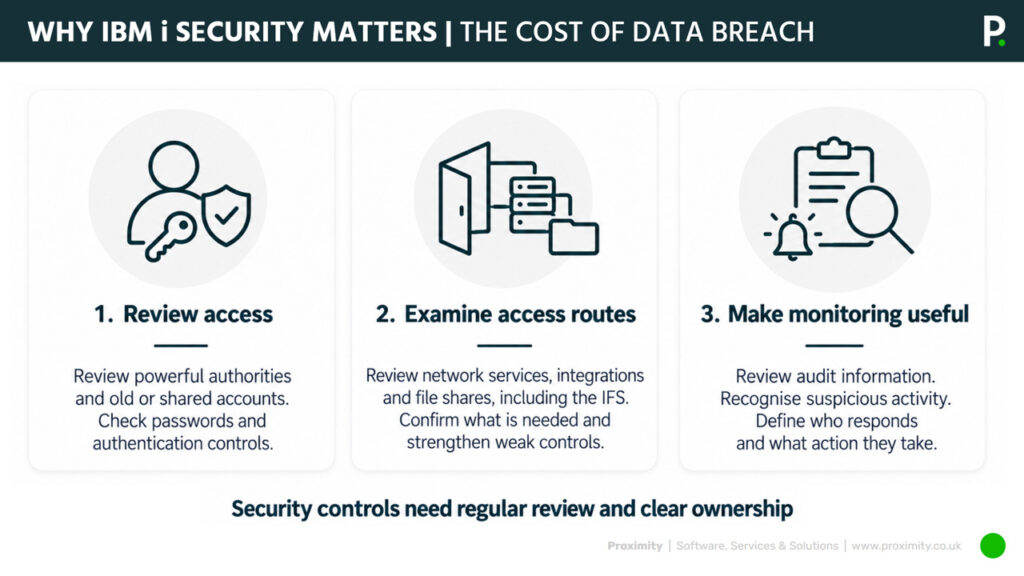
First, review access, – who has powerful authorities, and do they still need them? Are old or shared accounts creating unnecessary exposure? Are password and authentication controls appropriate?
Second, examine the routes into the system – review network services, integrations and file shares, including access to the Integrated File System. Establish what is needed and where controls need strengthening.
Third, make monitoring useful – collecting audit information is only the beginning. Someone needs to review it, recognise suspicious activity and know what action to take.
IBM provides the tools to capture that information, but organisations still need clear ownership, regular review and a defined response process.
There is a positive side to the AI story, too.
The joint warning also highlights how AI can help defenders find and fix weaknesses. Organisations should explore that opportunity alongside the fundamentals.
For businesses that depend on IBM i every day, this is about protecting the operation: the orders, stock, financial information and services that keep things moving.
So, a useful question to take away would be, “When did we last check that our IBM i security is working as intended?”
If that piques your interest and you’d like to explore this further, my article looks at the risks and the controls in more detail. You can find the post here
ACS security release – fixing 3 vulnerabilities
IBM has released ACS 1.1.9.16, addressing three newly disclosed vulnerabilities.
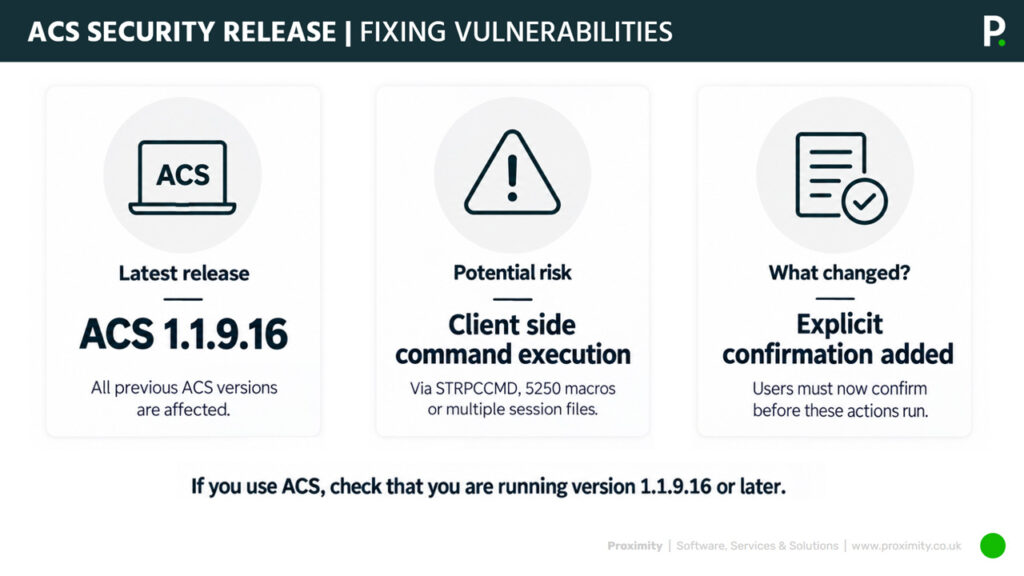
IBM says all previous ACS releases are affected, with the potential for commands to be executed through functions including STRPCCMD, 5250 macros and multiple-session files.
The new release adds explicit confirmation before those actions can run, so if you use ACS, it’s worth checking that you’re running 1.1.9.16 or later.
The 13th Annual Fortra Marketplace Survey is now open
In the middle of September, Fortra launched the 2027 IBM i Marketplace survey, their 13th annual release to the IBM i community.
This years survey is open until November 20th, and I took some time to speak with fellow IBM champion and Fortra stalwart, Mike Davison and first asked why it is important that you the reader (or viewer) adds their voice?
The annual IBM i Marketplace Survey has been running for more than a decade and has become one of the community’s most useful indicators of the health and direction of the platform.
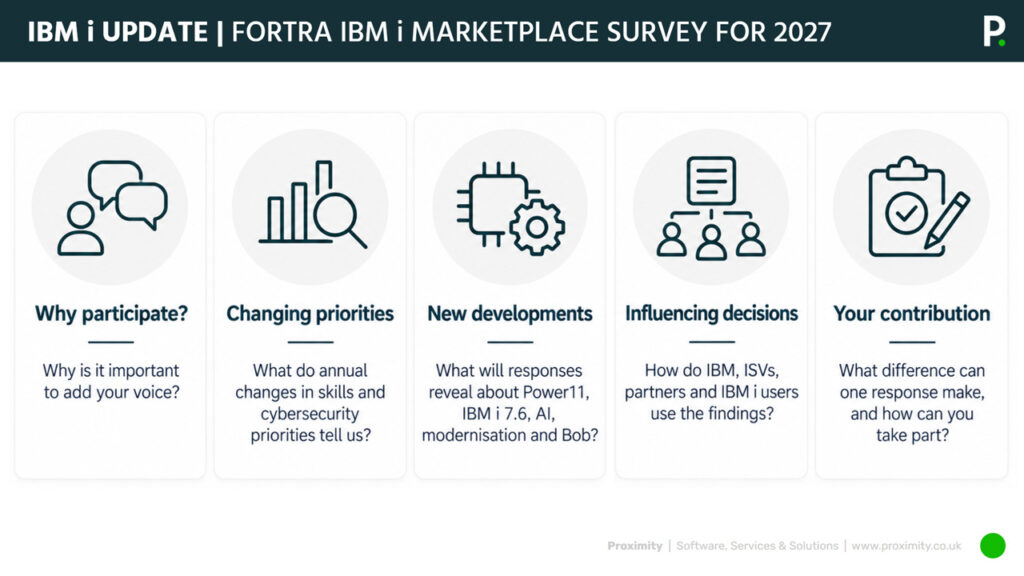
Following the launch of the 2027 survey, I spoke with fellow IBM Champion Mike Davison from Fortra about why people should participate, what Fortra hopes to learn this year and how organisations across the IBM i ecosystem use the results.
Andy Nicholson: Mike, the IBM i Marketplace Survey has been running for more than a decade. Why is it important for someone who has never participated before to add their voice to the 2027 survey?
Mike Davison: It is important because it helps all of us who use the operating system to shape the future of the platform.
As an individual, you may not have an opportunity to make your views known directly to the IBM i Advisory Council. The survey gives you a way to have your say. The more responses we receive, the stronger the data becomes and the more accurately we can identify the trends affecting the industry.
This year, the survey is also available in French, German, Italian and Spanish. We want to extend its reach across Europe and Latin America and create a much more global picture of the IBM i community.
Understanding trends and directions for the IBM i platform
Andy Nicholson: We have seen some significant changes in the results over the years. Last year, for example, IBM i skills overtook cybersecurity as the community’s biggest concern. How important are those year on year changes, and what do they tell us about where the market is heading?
Mike Davison: The changes are vitally important because they show the trends and direction of the platform.
Previous surveys have highlighted movement towards the cloud and then back towards hybrid environments. They have also shown growing concerns around the loss of IBM i skills, the increasing importance of security and the relatively slow movement between operating system releases and generations of Power servers.
Artificial intelligence is now another major area. Even in last year’s results, we saw a noticeable increase in the number of organisations exploring AI use cases.
Taken together, the answers help us understand the community’s commitment to IBM i and identify the strong and weak points within the businesses using the platform.
Topic highlights for this years IBM i Marketplace Survey
Andy Nicholson: There is an enormous amount happening around IBM i at the moment, including Power11, IBM i 7.6, artificial intelligence, application modernisation and tools such as IBM Bob. Are there any areas of this year’s survey that you are especially interested in?
Mike Davison: I am particularly interested in whether organisations plan to expand their use of IBM i, maintain their current position or move away from the platform.
It is also important to understand how many smaller IBM i shops are out there. The community is not only made up of large organisations with hundreds of logical partitions. There are many businesses operating one or two partitions or running a single Power server, and those organisations count too.
I am always interested in the adoption of open source technologies and the security features that organisations are using.
This year, however, I am especially interested in the IBM i skills challenge. As experienced professionals retire, we need reliable information that will help the industry understand how it can better support platform users.
Using the Marketplace Survey results to shape plans and make decisions
Andy Nicholson: Once Fortra publishes the results, who pays attention to them? Do IBM, software vendors, business partners and organisations running IBM i use this information to shape their plans?
Mike Davison: The industry quotes the results extensively. At almost every physical IBM i event I have attended this year, I have seen information from the Marketplace Survey included in a presentation.
That includes IBM events, business partner events and user group meetings. Managed service providers also use the findings to demonstrate the direction of the market and discuss the trends that matter to their customers.
The results provide valuable evidence about the state of the platform. IBM, independent software vendors and service providers can use that evidence when developing their plans, services and product roadmaps.
Why should people complete the IBM i Marketplace Survey?
Andy Nicholson: Finally, what would you say to someone who thinks their individual response will not make much difference?
Mike Davison: I would tell them that it does make a difference.
The results help IBM shape the future of its products and services. Independent software vendors use the findings when developing their roadmaps, and IBM has said many times that the survey results are considered at the highest levels of the organisation.
If you do not use your voice, you will not be heard.
We would love to increase participation from around the world. Historically, the results have sometimes been heavily weighted towards North America, so responses from the UK, Europe and other international markets are extremely valuable.
The survey takes less than five minutes to complete. You can find it through the Fortra website, LinkedIn and IBM i community publications such as the IBM i Update and Power Sockets.
Complete the 2027 IBM i Marketplace Survey
The survey remains open until the end of November, but there is no reason to wait. Please follow the link below and take a few minutes to add your voice to the 2027 IBM i Marketplace Survey.
- English: https://www.surveymonkey.com/r/Power-Fortra-Survey
- French: https://www.surveymonkey.com/r/Power-Fortra-Survey?lang=fr
- German: https://www.surveymonkey.com/r/Power-Fortra-Survey?lang=de
- Italian: https://www.surveymonkey.com/r/Power-Fortra-Survey?lang=it
- Spanish: https://www.surveymonkey.com/r/Power-Fortra-Survey?lang=es
Pricing for Power S1112 – The new Power11 entry level server
Great news as there’s now a clearer picture of what IBM’s new entry-level Power11 server, the Power S1112, might cost, and for some, these costs may be a surprise.
Yes, earlier this month, IT Jungle published pricing examples supplied by US reseller Data Tech Computer Services.
For example, A four-core rack configuration, with 64 gigabytes of memory and 1.6 terabytes of flash storage, is quoted at 41,950 US dollars.
A similarly specified tower comes in at 42,300 dollars. While a larger rack example with 128 gigabytes of memory, 12.8 terabytes of installed flash and a tape adapter reaches 88,000 dollars.
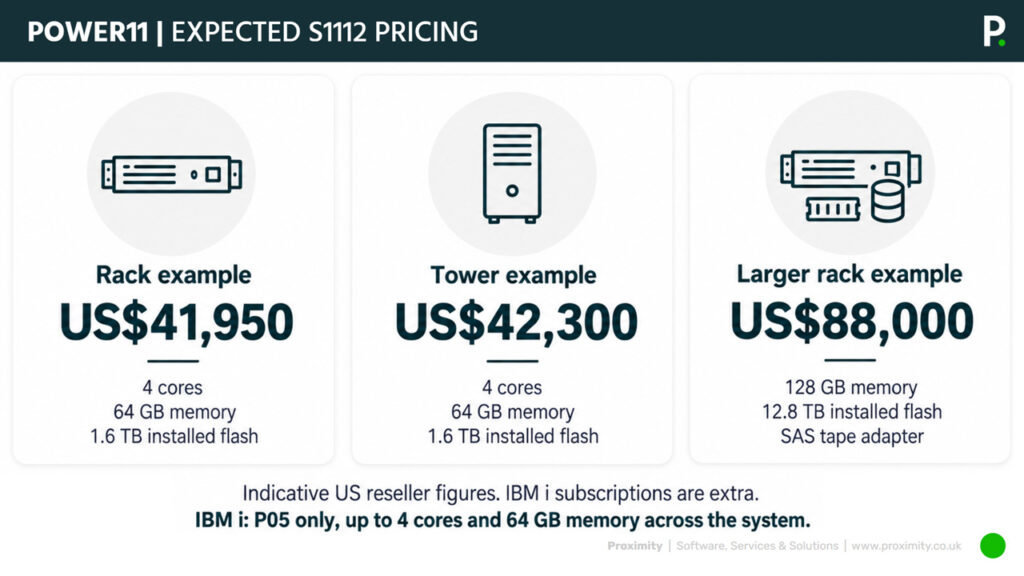
And, these are useful reference points for budgeting. It’s worth bearing in mind that any IBM i subscription charges are additional. Also, these are US prices, and local prices may vary
So, the published figures give us a useful starting point.
The next step is establishing what a properly sized, fully costed replacement would mean for your business.
Java on IBM i gets a Q3 refresh
And finally, we have the recently announced Q3 refresh for Java on IBM i, cementing IBM’s long-running commitment to the language.
In this Q3 refresh, IBM brings the supported runtimes up to their latest maintenance levels, including updates for Java 21, 17, 11 and 8. The versions available depend on which IBM i release you are running, as shown here.
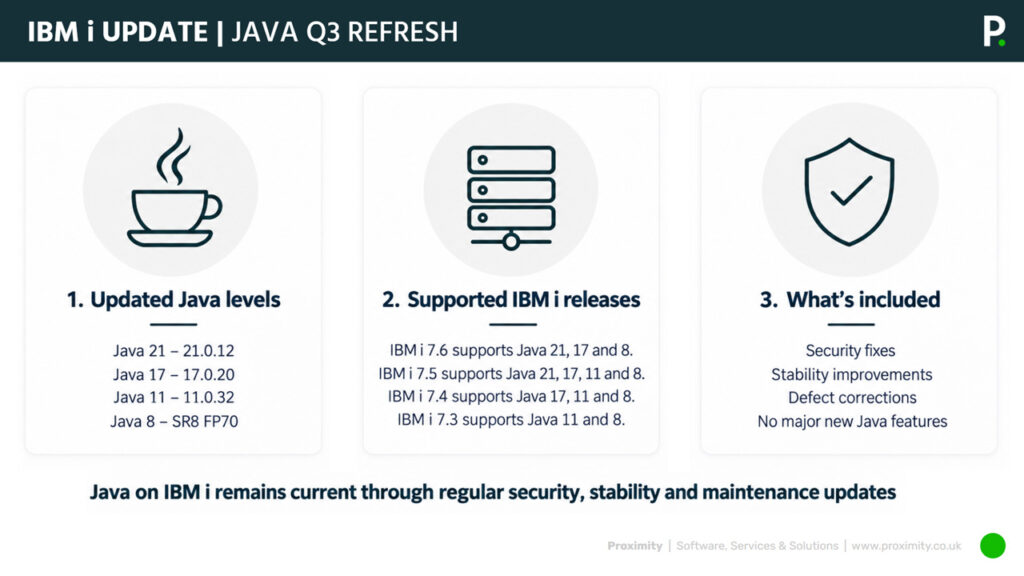
This refresh focuses on security fixes, stability improvements and defect corrections rather than major new Java features, helping organisations keep their Java workloads current and properly supported.
And that’s it for your IBM i Update.
I’m Andrew Nicholson, and we’re Proximity, your application support, maintenance and development partners who are in your corner.
If you missed it, you can check out my previous update here, or access all the IBM i Updates in one place.
Alternatively, if you’d like to receive the latest IBM i Update hot off the press to your inbox, subscribe to the IBM i Update on LinkedIn.