Welcome to your IBM i update for February 2026, your monthly digest into what’s happening within the IBM i community.
In this edition, we’ll look at the 2026 results of the Fortra IBM i Marketplace survey and discuss what they mean and analyse the trends using the previous years’ data.
You can watch the video above or read the blog post below.
Demographics of the Fortra Marketplace Survey 2026
At the beginning of February, we enjoyed the release of the FORTRA 2026 IBM i Marketplace Survey.
This is the 12th edition, and this year surveyed over 360 IT professionals across multiple industries – the majority (22-23%) being Administrators, IT Managers and Others, with developers representing 16% of respondents and 13% at Director or VP level.
So, a good spread.
The global respondents were pretty much the same as the past couple of years, and again, were dominated by the USA and Canada.
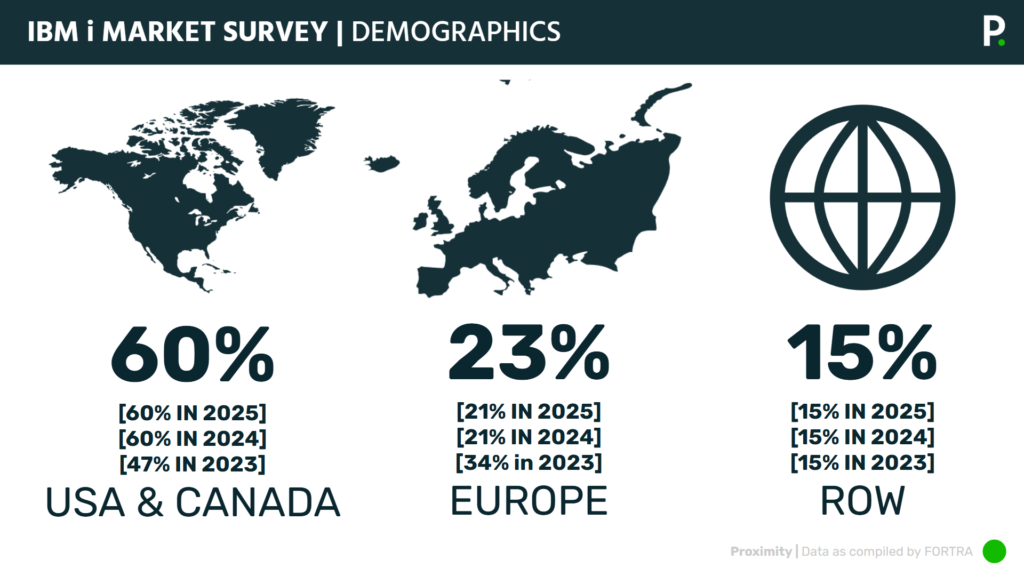
In Europe, we’re up a couple of percent high than last year with a move to 23%, but still a considerable drop from the all-time highs in 2023. And the rest of the world remains at 15%.
Now, as last year, the astute amongst you will notice that the figure doesn’t add up to 100% but as before, this has to do with large multinationals responding.
A strong commitment to the IBM i platform
The survey found a strong commitment to the platform with those looking to increase their IBM i footprint at 19%, up 7% on 2024.
Retaining the status-quo is down a few points, and a continuing downturn was with companies staying on IBM i but migrating to cloud. Down from 13% in 2024 to 5% in 2026.
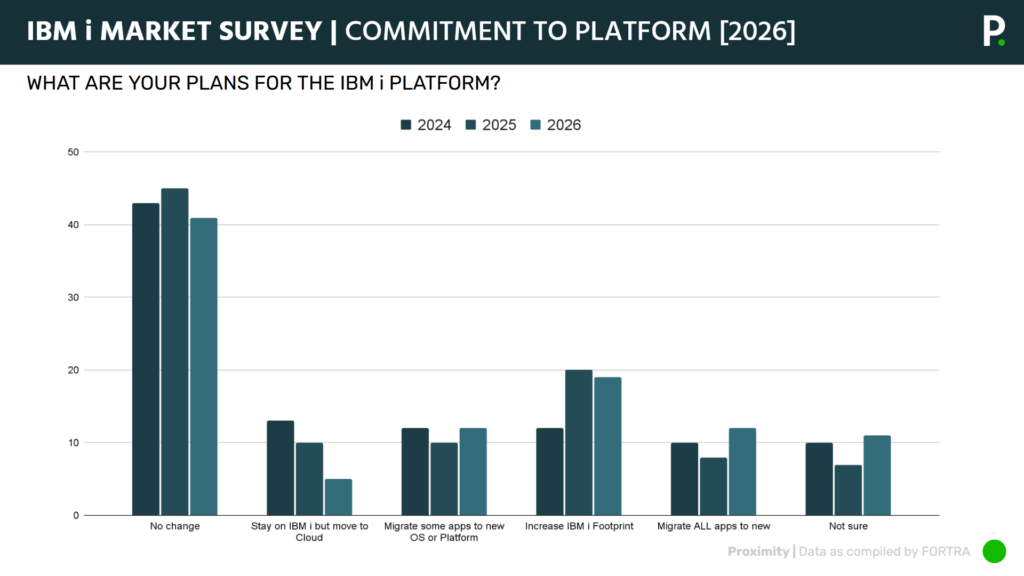
Now, this could be seen as positive news as businesses move from a ‘no change’ standpoint to furthering their investment in IBM i however, the caveat here is an increase in migration of all apps to a new OS or platform, up from 8% in 2025 to 12% this year.
Is the IBM i platform a good investment?
The positivity continues with 95% of respondents rightly thinking that IBM i continues to be a good investment for their business.
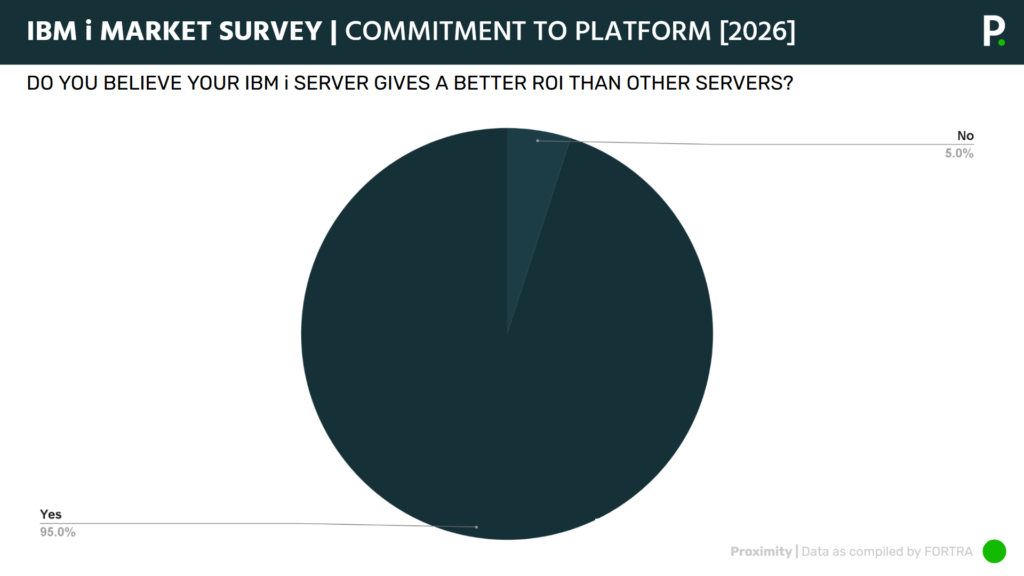
This has been bobbing in around this area for the past few years and we see this trend continuing with the added resilience and performance of the Power 11.
The percentage of the majority of core business applications running on the platform is up from 5% to 47% with a further 27% having half to three quarters of their applications on IBM i at the heart of their business.
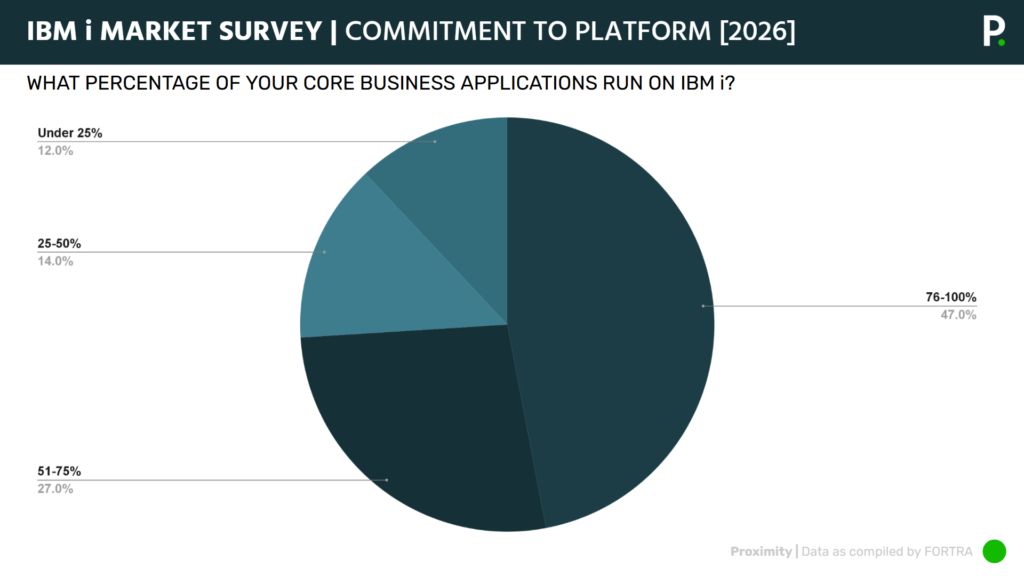
Indeed, the 25-50% bracket is down 1% from last year and with the upturn of 5% within the ‘majority’ bracket, this suggesting a significant proportion of business workload is increasingly predominantly run on the IBM i.
Main development code languages on the IBM i
RPG continues to be the mainstay, followed by SQL, but both are slightly down on the year previous.
COBOL remains static at 16%.
No huge surprise here, due to its continued presence in the financial sector and its rock-solid reliability.
The modern ‘web’ languages continue to eclipse COBOL with a continuing uptake of Python plus continued good adoption of PHP and Node.js.
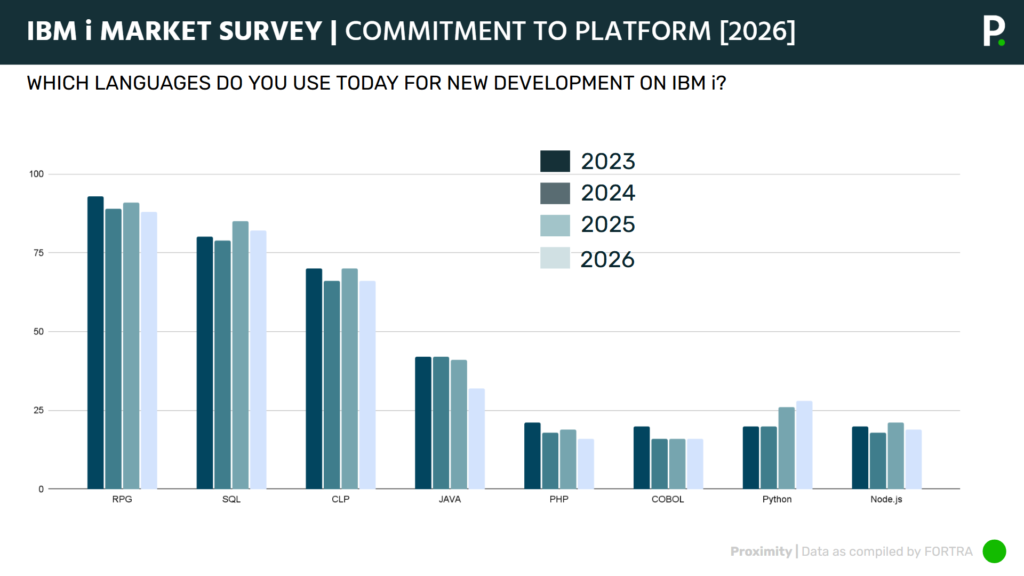
One interesting change was in Java however, which had a noticeable drop from 40% to 32 – one thing that Fortra noted was that it may be possible that respondents are not listing languages in which they are receiving AI assistance?
If correct, these are all good signs for modernisation.
Continuing with development, Apache retains its position as the top open-source development tool. Unsurprisingly GIT retains its popularity in second place and I would expect to see this trend continue in the coming years too.
The other big gain in 2026 is perhaps in the ‘others’ category as new and exciting open source tools are adopted to support modernisation and API development.
Skills gap overtakes Cybersecurity as #1 concern amongst IBM i professionals
But the highlight is always the top concerns for the IBM i enterprise and, for the first time in almost 10 years, Cybersecurity is NOT the number one concern amongst IBM i professionals.
The number one slot has been taken by IBM i Skills up nearly 10% from last year to 69%. To put that into context, last year Cybersecurity got 77% of the vote in 2025, this year, it drops down to 64% – so quite the pivot.
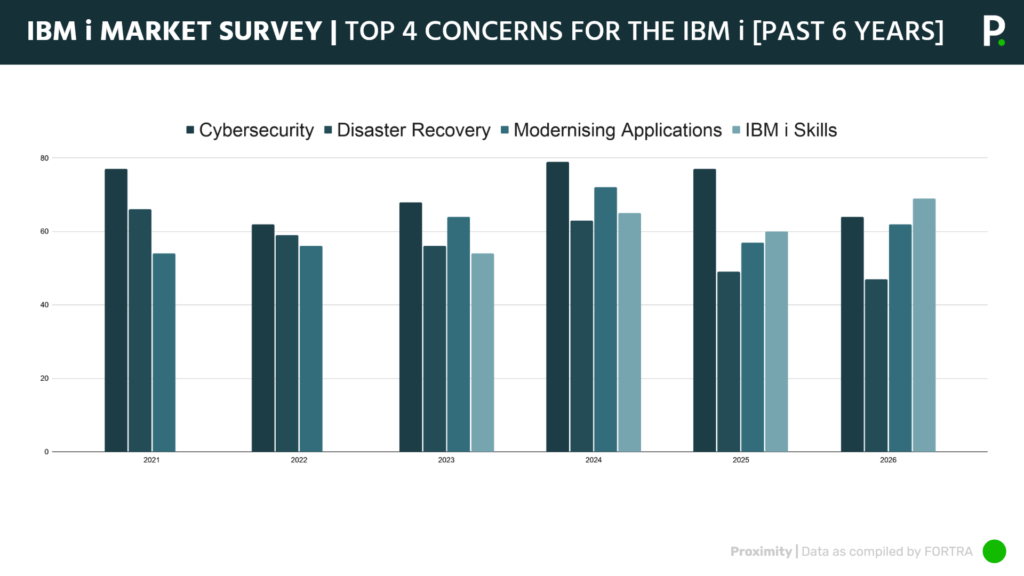
What this tells us is that the biggest risk isn’t hackers, it’s retiring developer.
So, before we close, some of the takeaway highlights from the survey. First is with the growing interest in artificial intelligence and machine learning.
Not covered in my previous chart but this year, it ranked 5th in the concern ranking with 42% of the casting vote.
However, the bigger picture here is in the trend line.
Now, if you go back to 2024, this was at just 18%, so a massive leap of 24% in just two years. This demonstrates a legitimate interest in these technologies to support everyday business processes.
AI has moved from a curiosity to active planning where IBM i teams are thinking on how they can use AI, where it may fit and if they are prepared for it.
And some may be more prepared than others as 73% of IBM i systems run fully unattended after working hours.
This shows us that IBM i shops are already highly automated and while this may be with nightly batch processes, and scheduled jobs – it demonstrates that the IBM i is a strong platform to build automation within – AI can only help in this area too.
Trust and satisfaction maintain a high level with 95% of respondents believing that the IBM i gives them a better ROI than other platforms.
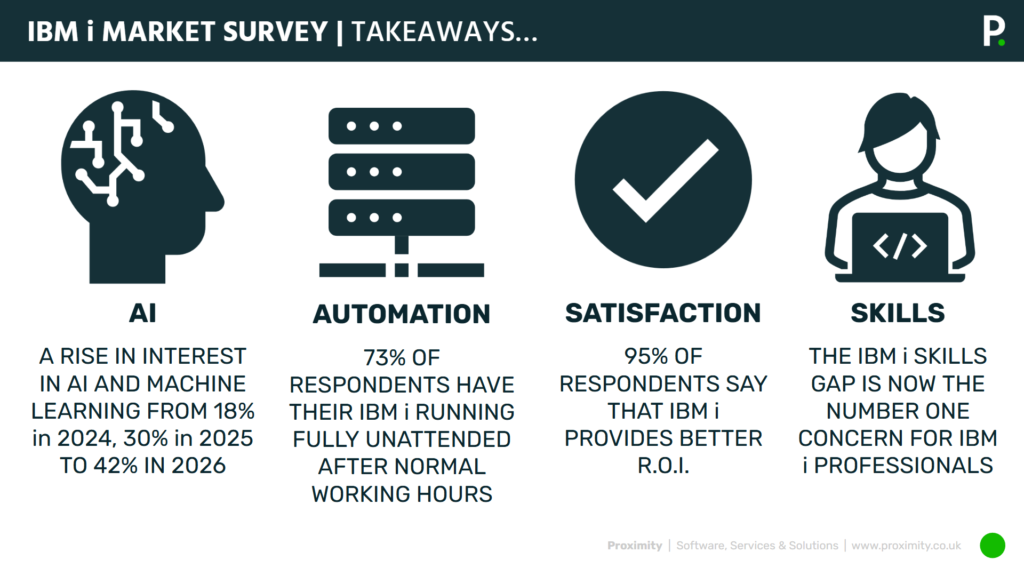
But the same people are saying that there is a gap in skills to support, maintain and develop the systems, with 69% of respondents listing IBM i skills as a top concern when planning their IT environment.
Indeed, the Skills Gap is the biggest takeaway in this year’s Fortra Marketplace Survey.
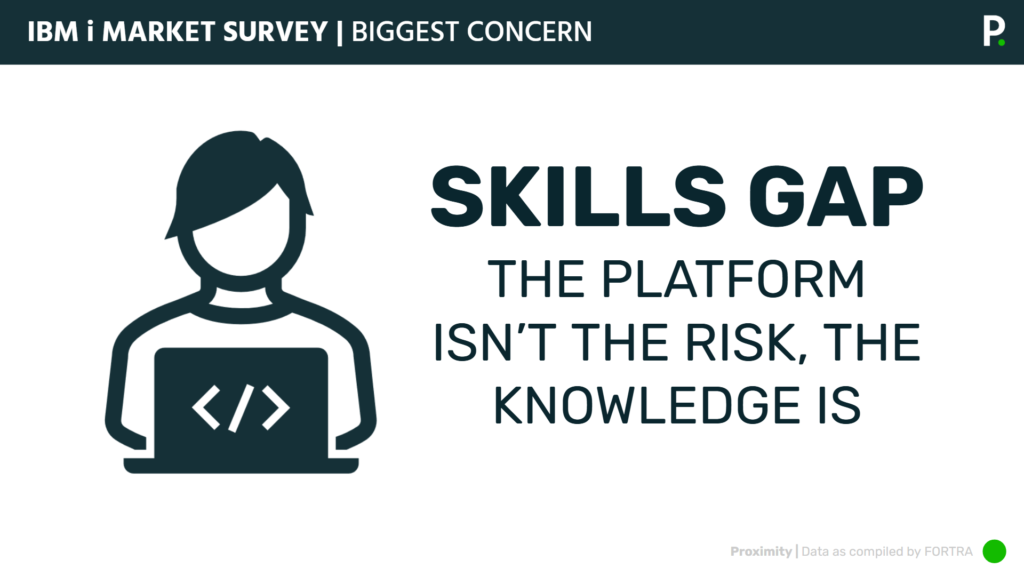
The fact that IBM i skills has overtaken cybersecurity as the number one concern… Well that’s a big moment for the platform.
What it tells us is that IBM i itself isn’t the risk, the challenge is finding people with the experience to support and modernise these systems as teams get smaller and developers retire.
And we’re seeing organisations respond in a few ways: investing in training, using AI tools to help new developers learn faster, improving automation… and increasingly, partnering with specialist managed service providers (such as Proximity) to provide continuity and resilience around their IBM i applications.
Because for many companies, the goal isn’t to replace IBM i but to make sure they’ve got the right skills around it for the long term.
And that’s it for this update and of the IBM i Marketplace Survey.
Follow the link here for the full survey as compiled by Fortra.
And for more like this and to subscribe to the IBM i Update, please see our blog on the proximity website and on LinkedIn too, but for now, I’m Andrew Nicholson, we’re Proximity your application support, maintenance and development partners that are in your corner.
All the best.
If you missed it, catch up on our December IBM i update.
Follow this link to access all the IBM i Update’s in one place.
Alternatively, if you’d like to receive the latest IBM i Update hot off the press to your inbox, subscribe to the newsletter version on LinkedIn.